
The Ottoman Mushaf Tradition: From Sheikh Hamdullah to Hasan Riza
Writing a mushaf was the hardest test an Ottoman calligrapher could face. A short reading of the six names who shaped the tradition.
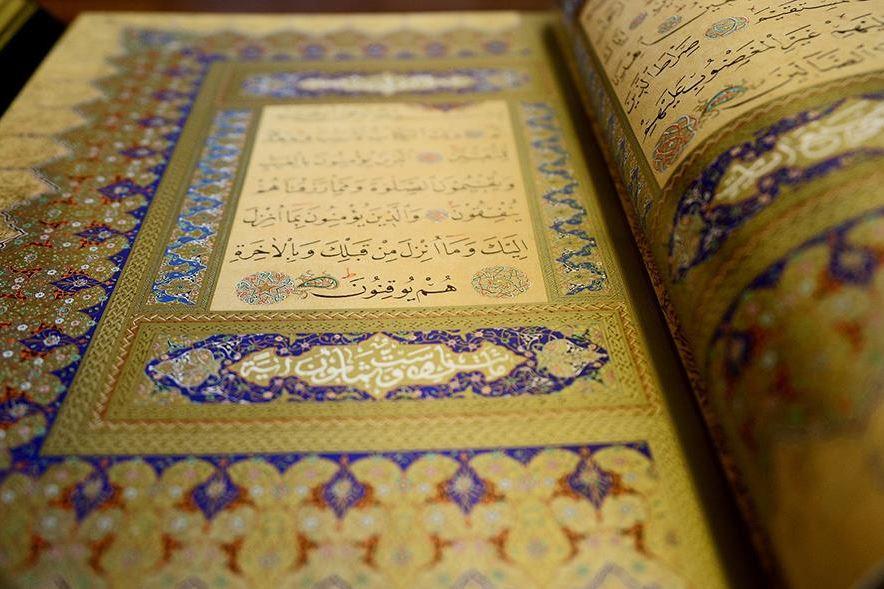
Writing a mushaf is the hardest task through which an Ottoman calligrapher could show mastery. Thousands of lines must look as though they left the same hand on the same day, the page layout must hold from beginning to end, and the proportions of the letters must survive a work that can take years. Below is a brief look at a few of the names who shaped this tradition.
Sheikh Hamdullah (1429–1520)
Born in Amasya, Sheikh Hamdullah taught calligraphy to Sultan Bayezid II while the latter was still a prince. He reinterpreted the six scripts — whose proportions had been set before him by Yaqut al-Musta'simi — according to Ottoman taste, and the measure he gave to thuluth and naskh was treated as the standard for the four centuries that followed. Hence his title among calligraphers: qiblat al-kuttab, the direction to which scribes turn.
Ahmed Shemseddin Karahisari (c. 1468–1566)
Karahisari stood outside the line of Sheikh Hamdullah, continuing the Yaqut manner in his own interpretation, and is remembered as an unrivalled master of jali thuluth in particular. The large-format mushaf he wrote at the command of Suleiman the Magnificent is among the most magnificent examples of Ottoman book art; when the calligrapher died before completing it, the work was finished by his student and adopted son Hasan Chelebi. The original is held in the Topkapı Palace Museum Library.
Hafiz Osman (1642–1698)
Hafiz Osman took up the Sheikh Hamdullah manner again and pared it down. The mushafs and hilyes he produced became direct models for the calligraphers who came after him. The image that comes to mind today when one thinks of Ottoman naskh is largely his.
Shekerzade Seyyid Mehmed Efendi (d. 1753)
During his years at the Prophet's Mosque in Medina, Shekerzade wrote a mushaf modelled on that of Sheikh Hamdullah. Much later this copy would serve as the basis for the first officially printed Ottoman mushaf, bridging the manuscript tradition and the printed book.
Kayishzade Hafiz Osman Nuri (d. 1894)
The mushaf written by Kayishzade Hafiz Osman Nuri Efendi at the end of the nineteenth century is known for its ayet-ber-kenar arrangement, in which every page ends with a complete verse. Almost all later printed mushafs adopted this arrangement; the page structure of many Qur'ans in circulation today rests on it.
Hasan Riza Efendi (1849–1920)
Known for his work in thuluth, jali and ta'liq, Hasan Riza Efendi was among the last great masters of naskh. The large-format mushaf commissioned by Sultan Mehmed V Reshad after his accession, to be recited at his tomb, is held in the Topkapı Palace Museum Library.
Seeing these works today
Most of the mushafs named here sit in library and museum storage for conservation reasons, and seeing them together is not possible. This is exactly where facsimiles earn their place: by carrying the size, the binding, the page layout and the illumination across faithfully, they bring these manuscripts to the desk.